Montreal International Game Summit

Welcome-Sign-MIGSI’ve just returned from the Montreal International Game Summit, at the Palais des congrès de Montréal.

It’s an enormous building, with a streetfacing wall of rainbow-tinted glass that casts striking patterns of light on the floors when the sun is shining. Also, a small forest of hot pink tree trunks decorates the ground level.

For a convention center, there’s no shortage of color and whimsy at the Palais des congrès de Montréal.
It was a pleasure to be able to speak at this summit for the first time. I’ve composed music for a number of games that were either developed or published by Canadian companies. These include Assassin’s Creed Liberation, Fighter Within, and Spore Hero. This made it especially exciting for me to address such a creative and inspirational gathering as the game development community in Montreal!

MIGS-Speech-WinifredPhillips

My session was entitled Assassin’s Creed Liberation: The Power of Musical Themes. A video of my talk has been posted to YouTube:

It was exciting to address an audience that included some of my peers from the Ubisoft development studios in Montreal. Ubisoft had a very strong presence at MIGS. Here’s a photo of one of their displays in the convention center:

Ubisoft-Display-MIGS

My talk about the music of Assassin’s Creed Liberation went very well, and I thoroughly enjoyed meeting people after the session and further discussing some of the ideas I’d shared in my session talk.

The view from the convention center was very impressive. This is a photo I took quickly as I ascended the escalators.

View_From_Palais-MIGS

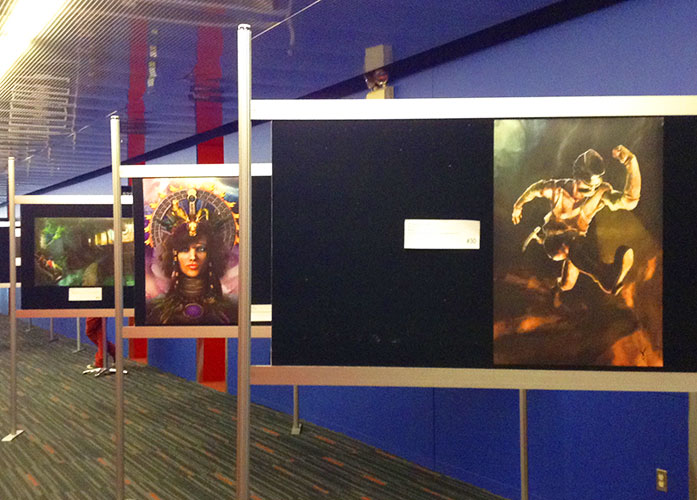
The MIGS art gallery was beautiful and inspired.

gallery-MIGS

I enjoyed the MIGS VIP cocktail reception. Below is a photo of the sea of cupcakes that greeted attendees at the reception. The cupcakes offer helpful hints regarding the direction in which game development will go in the coming years.

VIP-Cocktail-Cupcakes-MIGS

I had a fantastic time speaking at MIGS. Thanks to everyone I met this week in Montreal – it was a pleasure!

GameSoundCon 2013

GameSoundCon-Sign

I’ve just come back from a fantastic experience at GameSoundCon, the premiere conference on game music and sound design. It was great to see so many old friends and new faces, and I really enjoyed the conference’s expansion into the LA Convention Center. I’m usually there every year for E3, which is always a mind-blowing spectacle, so revisiting the place when it’s less hectic was a welcome change of pace.

Speaking at GameSoundCon 2013

Speaking at GameSoundCon 2013

This was my first time speaking at a GameSoundCon event, and the audience was very welcoming. My session, From LittleBigPlanet to Assassin’s Creed Liberation: Adventures in Melodic Composition, took place on the second day of the conference, during the Game Audio Pro track for experienced game industry folks. It was a pleasure to share some tips and techniques, and I really appreciated the warm reception I received. Special thanks to those of you who came up to me afterwards and talked to me about your own experiences. It was wonderful meeting you!

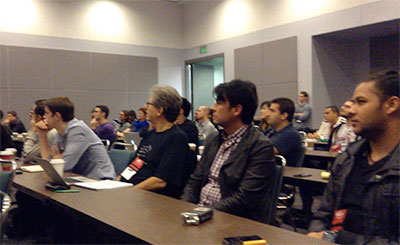
A portion of the audience for my presentation at GameSoundCon

A portion of the audience for my presentation at GameSoundCon

As an added bonus, the GameSoundCon event took place immediately preceding GDC Next, and they were both located in the LA Convention Center, so I was able to attend both events. The expo floor for GDC Next was especially enjoyable, since it included booths for a lot of smaller mobile and app developers that can sometimes be overshadowed at larger shows like GDC.

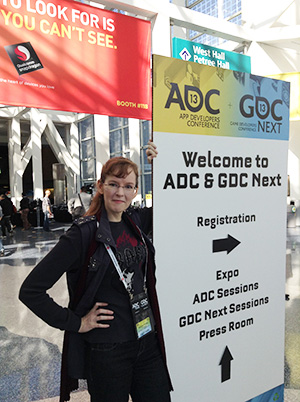
GDC-Next

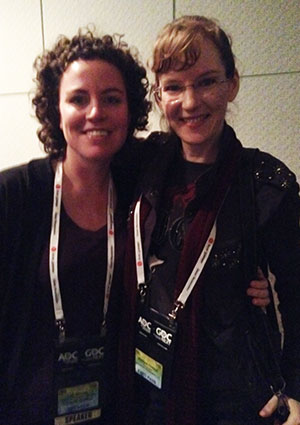
Also, I had the opportunity to attend a GDC Next presentation by the Writers Guild of America award-winning co-writer of Assassin’s Creed Liberation, Jill Murray. Her presentation focused on how to incorporate compelling female protagonists into all sorts of intriguing game concepts. She did a fantastic job, and it was great seeing her there!

Jill Murray

What Should Be Louder – Pop Art or High Art?

This week I’d like to recommend an interesting research article written by game audio director Rob Bridgett, entitled “Dynamic Range: Subtlety and Silence in Video Game Sound.” The article describes a crisis in the field of video game audio. The crisis stems from the desire of game audio practitioners to present a ‘cinematic’ audio experience, pitted against the trend of dramatically compressing the audio in order to maximize its perceived loudness. The article asserts that these two approaches are incompatible, and there is one portion of the article that particularly caught my attention.

Rob Bridgett, Audio Director of Best Boy Entertainment

Rob Bridgett, Audio Director of Best Boy Entertainment

Bridgett asks if a game will be considered “a cultural artifact,” and if so, “is it high art or is it pop art?” According to Bridgett, this determination should guide the game audio staff in terms of how compressed a game’s audio should be. High art (which Bridgett defines as a work of art designed to emulate a cinematic presentation) should employ a wide dynamic range, with little compression. Bridgett points out that Hollywood films are mixed with a wide dynamic range, and that this mixing tactic is the most effective approach for projects that fall into the ‘high art’ category. In contrast, ‘pop art’ (such as “party games or children’s games” according to Bridgett) will likely be played in more noisy environments and should therefore be more aggressively compressed so that the audio can compete with other sounds in the game play space. These games are experienced differently from ‘high art’ games, and their sound should reflect these differences, according to Bridgett’s article.

Using the artistic status of a video game as a determinant of how that game’s audio should be mixed is an interesting point of view, as well as a uniquely arresting one. The opportunity for discussion here is enormous. Is high art necessarily cinematic in nature? Some games that aren’t particularly interested in a cinematic presentation could be considered high art nevertheless (Echochrome springs to mind). On the other hand, a lot of games that are interested in a cinematic presentation don’t seem to be interested in becoming high art (such as Killer Is Dead). Yet, we can certainly point to supposedly ‘high art’ games that are tremendously cinematic (God of War) and ‘pop art’ games that are not (Mario Party 9). Should Mario Party 9 feel consistently louder than God of War?  Another question – should all cinematic presentations have a very wide dynamic range? For instance, some recent summer blockbuster films in the superhero genre have felt fairly compressed to my ears – but then, we might consider those to be more in the ‘pop art’ arena.

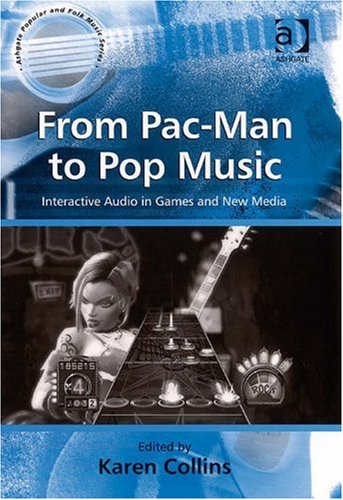
The idea of categorizing games by their status as cultural artifacts and then mixing their audio accordingly seems like a tremendously complicated subject. But I do like the idea of considering the basic nature of a video game and its intended audience before making decisions about its dynamic range. When so much discussion is going on regarding the creation of universal standards of dynamic range in the game industry, ideas like those proposed by Bridgett seem well worth discussing. The article is a fascinating read, and you’ll find it in the book, From Pac-Man to Pop Music, edited by Karen Collins.

From Pac-Man to Pop Music: Interactive Audio in Games and New Media

From Pac-Man to Pop Music: Interactive Audio in Games and New Media

Speaking Engagement: GameSoundCon 2013

I wanted to let everyone know that I’ll be speaking at GameSoundCon, which takes place in Los Angeles on Nov. 3-4, 2013. It’s a fantastic educational summit in which game audio professionals give lectures, provide tips, discuss techniques and share insight into the process of creating great game music and sound. Held every year since 2009, the conference is run by Brian Schmidt. He’s a winner of the Game Audio Network Guild’s Lifetime Achievement Award, he’s an inventor for about 20 patents in audio and game technology, and he’s in the faculty of the DigiPen Institute of Technology.

I’m honored to be chosen to speak at this conference. I’ll be giving a talk in the GameAudioPro Track, which is designed to offer content for more advanced game audio professionals.  The conference takes place this year at the Los Angeles Convention Center. It’s the first time that GameSoundCon has been held there.

LACC

The conference will immediately precede GDCNext, which is taking place in the same venue. Since GDCNext doesn’t have an audio track, the synergy between the two events should be very complimentary!

Here’s one of the GameSoundCon lectures that Brian Schmidt gave at the 2010 GameSoundCon:

Also, you can read more about GameSoundCon at the GameDev.net site.

Finally, here is a review of last year’s GameSoundCon written by sound designer Uriel Salazar.


Speaking Engagement: Montreal International Game Summit (MIGS)

MIGS_EN

I’m excited to share some great news – I’ve been chosen to be a speaker at the Montreal International Game Summit!  I’m really honored that I’ll be attending as a speaker. MIGS will be held this year on November 11th and 12th. Information about my talk isn’t posted to the MIGS site yet, but it will be soon. MIGS is the biggest event dedicated to Canada’s video game industry, and it’s also the biggest game industry event on the east coast of North America. The keynote speaker this year will be Obsidian Entertainment’s creative director Chris Avellone. Very exciting!

Palais_Congress_Montreal

Here’s the beautiful convention center where the event takes place – the Palais des congrès de Montréal. 

I have a warm place in my heart for the Canadian game industry, having worked with both EA Montreal and Ubisoft Montreal, so it will be a real pleasure to speak to a gathering of such talented people. This will be the Montreal International Game Summit’s 10th anniversary. It’s also my 10th anniversary of working as a composer in the video game industry! MIGS will be a great way for me to celebrate my 10th year writing music for video games.

Rest in Peace, Game Developer Magazine

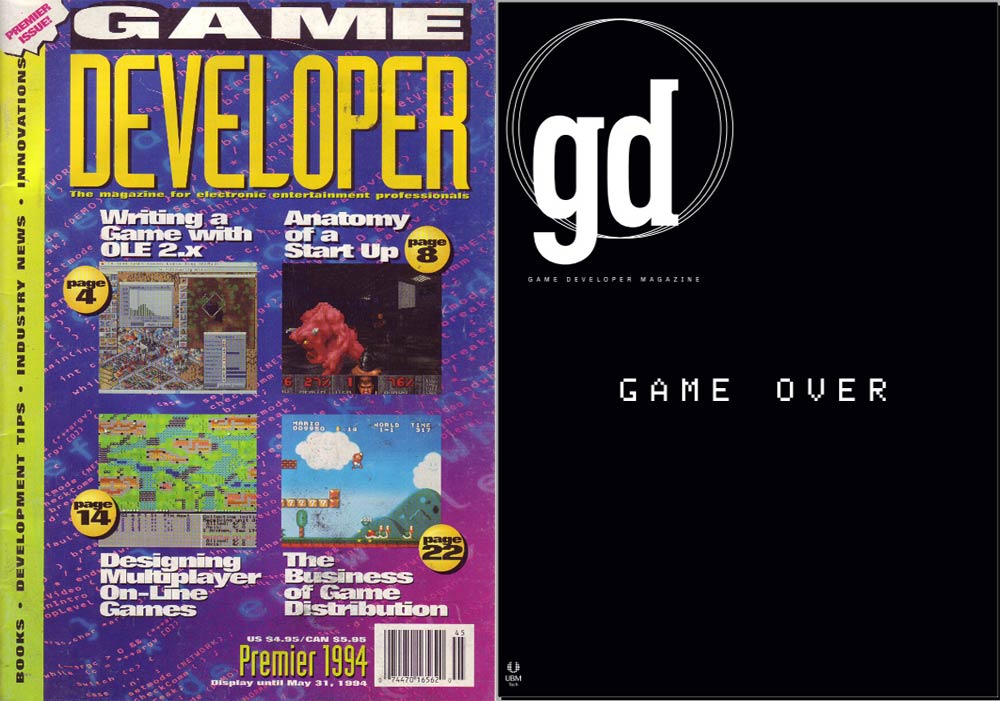
GDPremier&Final

I was incredibly saddened to hear that Game Developer Magazine was to cease publication. I’m looking at the magazine as I write this. It has a bleak jet-black cover with the words GAME OVER, dead center in plain white lettering. Those two words bring a pang to my heart.

When I attended my first Game Developers Conference, I was offered a free subscription to the magazine as part of my registration process. I signed up for the subscription right away – it was a bit of a thrill for me. For someone so new to game development, being offered that free subscription felt a little like a secret initiation – as though I had been found worthy of joining the community and would now receive the benefit of knowledge that only the insiders knew. Of course, I was well aware that this was a tremendous exaggeration, but a part of me clung to the conceit that the magazine subscription was a little rite of passage.

I rarely read the magazine in any organized, consecutive manner. Mostly, I enjoyed opening to random pages and reading whatever article I saw there. The Design of the Times articles were eye opening for me, providing tremendous insight into the struggles of designers. I had no idea that the pursuit of the fun factor would be so remarkably complex, requiring such a deep knowledge of psychology, economics, and the long and rich history of game systems from both the ancient past and the present day. With every issue, my appreciation for the struggles of game designers grew.

Articles about programming languages, artificial intelligence and physics were written in an arcane lingo that skimmed my consciousness in the same way that liturgical Latin might have done. This was the language of the ancient society of technicians, engineers and coders – it wasn’t meant for me. Nonetheless, I did read a lot of these articles, because now and then there would be a moment of humor, a glimpse of pathos and exhausted camaraderie, or a spark of enthusiasm and inspiration that would reach out of the labyrinthine text and capture my imagination. If I had overheard such a conversation at the watercooler, and one of the engineers noticed me listening and gave me a shrug and a smile… that feeling is close to how I sometimes felt, reading those articles.

The interviews were always surprising and interesting. It seemed to me that there must have been something about the journalists of Game Developer Magazine that inspired people to speak with startling frankness and gritty honesty. I read blunt observations about the video game marketplace. Successes and failures of games were discussed in the context of economic realities and the changing expectations of gamers. Prominent developers openly grappled with the problem of fitting their creative aspirations into a business model that sometimes couldn’t accommodate them. Triumphant developers crowed about their bestselling games, and hardened veterans shared war stories about the big hits that almost were.

Of course, I eagerly pored over the Aural Fixation column, since it focused on the audio side of game development. The technical articles were always fascinating, and this extended into the audio product reviews. Several products that I first learned about in Game Developer Magazine are now a part of my working life.

I loved the Arrested Development column at the back of the magazine, where the keenest observations about game development would come leaping out of the magazine, dressed in the disguise of sharp and irreverent humor. This sweetly acidic dessert at the end of the meal was always the perfect finish… but I’ll admit that I often ate dessert first.

As a magazine that depended on advertising revenue to stay afloat, Game Developer Magazine was wounded deeply when many of the companies making software development tools consolidated. Where before, there were many software companies buying ad space in the magazine, now there were only a few. For the magazine’s parent company, the meager profits simply couldn’t justify the continuation of Game Developer Magazine. The decision was made, and that final issue with the stark black cover was shipped out. GAME OVER.

Nothing I can write here could adequately pay tribute to Game Developer Magazine.  It provided me with a connection to an industry I loved. Every month, the magazine helped me to cultivate a deeper understanding of the struggles and successes of my fellow developers, and for that I am grateful. My heartfelt thanks go out to the writers and editors of Game Developer Magazine, for their creativity and their passion.  I’m sure that they will all find great opportunities awaiting them in the field of digital games journalism, and I am looking forward to reading their contributions… but I will miss the unique combination of talents and personalities that made up this dynamic team of writers.  Thanks to one and all for the many years of insight, instruction, and community spirit that you shared with me.  I’ll never forget it.

You can read the entire final issue of Game Developer Magazine in a free PDF that they’ve made available at this link. Below you’ll find a list of the former editors-in-chief of Game Developer Magazine, along with either their Twitter pages (if applicable) or their LinkedIn profiles.

Patrick Miller @pattheflip

Brandon Sheffield @necrosofty

Alex Handy

Jamil Moledina @jmoledina

Simon Carless @simoncarless

Jennifer Yeamans (Olsen)

Alex Dunne @adunne

Mark DeLoura @markdeloura

Larry O’Brien @lobrien