GameSoundCon Industry Survey Results

GameSoundCon

As the GameSoundCon conference draws closer, I thought I’d talk a little bit about the Game Audio Industry Survey that was designed by GameSoundCon Executive Producer Brian Schmidt.  The survey was prepared in response to the broader “Annual Game Developer Salary Survey” offered by industry site Gamasutra.  Since the Gamasutra survey suffered from skewed results for game audio compared to other game industry sectors (owing to lower participation from the game audio community), Schmidt set out to obtain more reliable results by adopting a different approach.

Instead of focusing on the yearly salaries/earnings of audio professionals, the survey concentrated on the money generated by the music/sound of individual projects. Each respondent could fill out the survey repeatedly, entering data for each game project that the respondent had completed during the previous year.  The final results of the survey are meant to reflect how game audio is treated within different types of projects, and the results are quite enlightening, and at times surprising.

GSC-SurveyThe financial results include both small-budget indie games from tiny teams and huge-budget games from behemoth publishers, so there is a broad range in those results.  Since this is the first year that the GameSoundCon Game Audio Industry Survey has been conducted, we don’t yet have data from a previous year with which to compare these results, and it might be very exciting to see how the data shifts if the survey is conducted again in 2015.

Some very intriguing data comes from the section of the survey that provides a picture of who game composers are and how they work.  According to the survey, the majority of game composers are freelancers, and 70% of game music is performed by the freelance composer alone.  56% of composers are also acting as one-stop-shops for music and sound effects, likely providing a good audio solution for indie teams with little or no audio personnel of their own.

A surprising and valuable aspect of the survey is to be found in the audio middleware results, which show that the majority of games use either no audio middleware at all, or opt for custom audio tools designed by the game developer.  This information is quite new, and could be tremendously useful to composers working in the field.  While we should all make efforts to gain experience with audio middleware such as FMOD and Wwise, we might keep in mind that there may not be as many opportunities to practice those skills as had been previously anticipated.  Again, this data might be rendered even more meaningful by the results of the survey next year (if it is repeated), to see if commercial middleware is making inroads and becoming more popular over time.

Expanding upon this subject, the survey reveals that only 22% of composers are ever asked to do any kind of music integration (in which the composer assists the team in implementing music files into their game). It seems that for the time being, this task is still falling firmly within the domain of the programmers on most game development teams.

The survey was quite expansive and fascinating, and I’m very pleased that it included questions about both middleware and integration.  If GameSoundCon runs the survey again next year, I’d love to see the addition of some questions about what type of interactivity composers may be asked to introduce into their musical scores, how much of their music is composed in a traditionally linear fashion, and what the ratio of interactive/adaptive to linear music might be per project.  I wrote rather extensively on this subject in my book, and since I’ll also be giving my talk at GameSoundCon this year about composing music for adaptive systems, I’d be very interested in such survey results!

The GameSoundCon Game Audio Industry Survey is an invaluable resource, and is well worth reading in its entirety.  You’ll find it here.  I’ll be giving my talk on “Advanced Composition Techniques for Adaptive Systems” at GameSoundCon at the Millennium Biltmore Hotel in Los Angeles on Wednesday, October 8th.

Many thanks to Brian Schmidt / GameSoundCon for preparing this excellent survey!

A Composer’s Guide to Game Music

Today, my book, A COMPOSER’S GUIDE TO GAME MUSIC, was released by the Massachusetts Institute of Technology Press.  It’s a huge day for me.

In December of 2011, I was finishing up work on my music contribution to LittleBigPlanet PS Vita when my music producer, Winnie Waldron, turned to me and said, “You should write a book about game music.”  Before that moment, it had never occurred to me that I might have something to share about my experiences as a game composer, so I initially laughed off her suggestion.  She paused, and then casually remarked that I should go and look over all those game audio books I owned (I have a pretty large collection) and then maybe ask myself if I had anything to say that hadn’t already been said.

A few days passed, and eventually I did look those books over. I took along a pad of multicolored sticky notes. Every time I felt like I could add something to what I was reading, I stuck a different colored note on the page, letting the edge hang out.  When I was done, I had a pile of books that looked like a rainbow had exploded inside them. Staring at all those little slips of paper convinced me to write the book.

I’ve been creating video game music for over 10 years, ever since my first project, God of War.  With every game score I composed, I learned so much… not only about the art and craft of game composition, but also about myself as an artist.  Game music composition is a thoroughly unique art form, imposing both technical and creative challenges that aren’t found in any other discipline. When I started in this profession, I didn’t really understand how complex everything would be… how much I didn’t know… how much I would need to learn.

A COMPOSER’S GUIDE TO GAME MUSIC is a guidebook, from my perspective as a game composer with experiences to share.  It’s been over two years since I first started writing it, and I’m very proud to say that my book has just hit retail. It’s out of my hands now, and I’m excited that see what readers think of it.  I hope it proves to be a helpful resource.  If you’re curious about my book, you can watch this video trailer.  I’m interviewed in the trailer, and I got the chance to talk a little bit about my reasons for writing the book, and what I hoped to share with readers.  Here’s that video:

My book is available for sale on Amazon.com.  If you choose to buy it, you’ll have my heartfelt gratitude!  And if you enjoy it, I’d be grateful if you share your thoughts about my book on its Amazon.com page. The launch of my book is a tremendously special day for me, and I’m happy to share it with you!

Montreal International Game Summit

Welcome-Sign-MIGSI’ve just returned from the Montreal International Game Summit, at the Palais des congrès de Montréal.

It’s an enormous building, with a streetfacing wall of rainbow-tinted glass that casts striking patterns of light on the floors when the sun is shining. Also, a small forest of hot pink tree trunks decorates the ground level.

For a convention center, there’s no shortage of color and whimsy at the Palais des congrès de Montréal.

It was a pleasure to be able to speak at this summit for the first time. I’ve composed music for a number of games that were either developed or published by Canadian companies. These include Assassin’s Creed Liberation, Fighter Within, and Spore Hero. This made it especially exciting for me to address such a creative and inspirational gathering as the game development community in Montreal!

MIGS-Speech-WinifredPhillips

My session was entitled Assassin’s Creed Liberation: The Power of Musical Themes. A video of my talk has been posted to YouTube:

It was exciting to address an audience that included some of my peers from the Ubisoft development studios in Montreal. Ubisoft had a very strong presence at MIGS. Here’s a photo of one of their displays in the convention center:

Ubisoft-Display-MIGS

My talk about the music of Assassin’s Creed Liberation went very well, and I thoroughly enjoyed meeting people after the session and further discussing some of the ideas I’d shared in my session talk.

The view from the convention center was very impressive. This is a photo I took quickly as I ascended the escalators.

View_From_Palais-MIGS

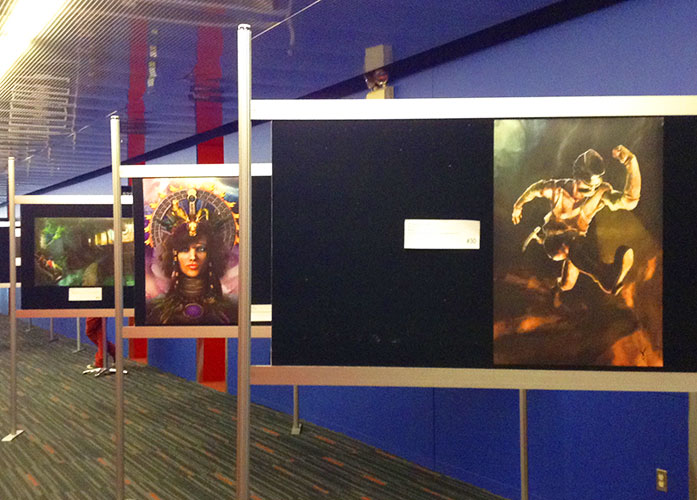
The MIGS art gallery was beautiful and inspired.

gallery-MIGS

I enjoyed the MIGS VIP cocktail reception. Below is a photo of the sea of cupcakes that greeted attendees at the reception. The cupcakes offer helpful hints regarding the direction in which game development will go in the coming years.

VIP-Cocktail-Cupcakes-MIGS

I had a fantastic time speaking at MIGS. Thanks to everyone I met this week in Montreal – it was a pleasure!

GameSoundCon 2013

GameSoundCon-Sign

I’ve just come back from a fantastic experience at GameSoundCon, the premiere conference on game music and sound design. It was great to see so many old friends and new faces, and I really enjoyed the conference’s expansion into the LA Convention Center. I’m usually there every year for E3, which is always a mind-blowing spectacle, so revisiting the place when it’s less hectic was a welcome change of pace.

Speaking at GameSoundCon 2013

Speaking at GameSoundCon 2013

This was my first time speaking at a GameSoundCon event, and the audience was very welcoming. My session, From LittleBigPlanet to Assassin’s Creed Liberation: Adventures in Melodic Composition, took place on the second day of the conference, during the Game Audio Pro track for experienced game industry folks. It was a pleasure to share some tips and techniques, and I really appreciated the warm reception I received. Special thanks to those of you who came up to me afterwards and talked to me about your own experiences. It was wonderful meeting you!

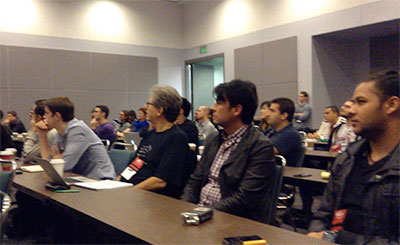
A portion of the audience for my presentation at GameSoundCon

A portion of the audience for my presentation at GameSoundCon

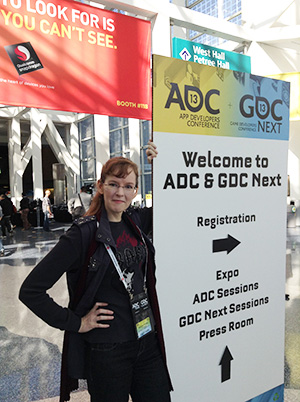
As an added bonus, the GameSoundCon event took place immediately preceding GDC Next, and they were both located in the LA Convention Center, so I was able to attend both events. The expo floor for GDC Next was especially enjoyable, since it included booths for a lot of smaller mobile and app developers that can sometimes be overshadowed at larger shows like GDC.

GDC-Next

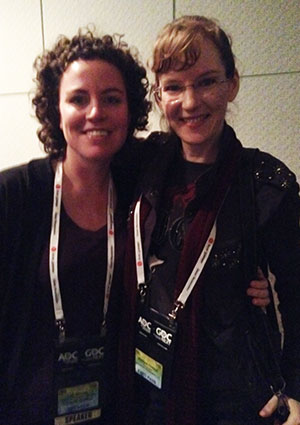
Also, I had the opportunity to attend a GDC Next presentation by the Writers Guild of America award-winning co-writer of Assassin’s Creed Liberation, Jill Murray. Her presentation focused on how to incorporate compelling female protagonists into all sorts of intriguing game concepts. She did a fantastic job, and it was great seeing her there!

Jill Murray

Sound Games

soundgames

Can sound be used as a primary gameplay mechanic? In this blog post, I’ll be showing you videos of a number of recent games that have tried to answer this question – they’re all fun and fascinating in their own ways.

As an audio content creator for the video game industry, I’m definitely intrigued by the trend of using audio as the primary mechanic in a video game. In an audio-driven game, the players have to use their ears in order to play – sound takes over the responsibility to deliver crucial gameplay messages to the player. Instead of audio providing support to a primarily visual experience, the audio-driven game turns that paradigm on its head, forcing the visuals into a supporting role for a primarily aural experience. To explain it another way, consider those players who sometimes prefer to turn off the sound of a game and simply rely on the visuals. In an audio-driven game, that would be impossible. On the other hand, players could conceivably turn off the visuals (or simply close their eyes) and still successfully play the game and enjoy themselves while playing it.

Papa Sangre is one of the purest examples of this approach. The game has almost no visual content at all, instead presenting only a rudimentary black-and-white dial for changing direction, and the image of two feet that propel your character forward when tapped sequentially. With this bare-bones interface, you navigate a lush aural environment. As a new arrival in the land of the dead, you navigate through total darkness, searching for your lost love. The game was created by Paul Bennun and the team at Somethin’ Else. Here’s a video demonstrating a few minutes of gameplay (best enjoyed wearing headphones).

While Papa Sangre is designed as a story-rich experience, Ear Monsters is a more casual game that relies on sound to drive gameplay. Gameplay involves killing invisible monsters by locating them based on their vocalizations. Again, the visual presentation is utilitarian and static, while the audio portion is more vibrant and active. Brian Schmidt of Ear Games created this game – he posted an interesting blog about the making of an audio game to the Gamasutra site. Here’s a tutorial demonstrating how to play Ear Monsters:

On the other end of the spectrum, a few games have experimented with the use of audio by the player as the primary method for controlling gameplay. One of my favorite examples of this is PewPewPewPewPewPewPewPewPew, created by Josh Schonstall and Ian Brock of IncredibleApe. As the name suggests, players control a sidescrolling shooter by saying “PewPewPew” into a microphone, which triggers the character to fire weapons. The game is hilarious to watch – here’s a video:

Another game I want to mention is more of a work of performance art. It could never actually be released to the public, although the public can play it when it’s displayed as an interactive art installation during game festivals, game music concerts and museum exhibitions. The game is called Cello Fortress, and was created by Joost van Dongen. In this multiplayer game, one of the players is always a cellist, who controls various forms of weaponry by virtue of specific musical articulations on the cello. Fast notes control guns, chords control flamethrowers, low notes control mines, etc. The cello player improvises a musical performance while also attempting to destroy a group of opponents, who control tanks by using traditional console controllers. It’s fascinating to watch – here’s a video:

Finally, I had the opportunity to compose music for a gameplay sequence in God of War that functioned as an audio-driven minigame. During the Desert of Lost Souls sequence, the player is tasked with locating an enemy during a blinding sandstorm. The enemy is the mythical Siren, who sings to lure unsuspecting warriors to their deaths. In this case, the player must disregard visual stimulus and focus on the location of the singing voice in the desert, following the sound until the Siren is reached and can be killed. I composed and performed the song of the Siren.  Here’s a link to a video of that gameplay sequence:

http://splicd.com/JlGK4EHpegM/12/39

Have you heard an audio-driven video game that you’d like to discuss here? Please share your experiences and impressions in the comments below!

What Should Be Louder – Pop Art or High Art?

This week I’d like to recommend an interesting research article written by game audio director Rob Bridgett, entitled “Dynamic Range: Subtlety and Silence in Video Game Sound.” The article describes a crisis in the field of video game audio. The crisis stems from the desire of game audio practitioners to present a ‘cinematic’ audio experience, pitted against the trend of dramatically compressing the audio in order to maximize its perceived loudness. The article asserts that these two approaches are incompatible, and there is one portion of the article that particularly caught my attention.

Rob Bridgett, Audio Director of Best Boy Entertainment

Rob Bridgett, Audio Director of Best Boy Entertainment

Bridgett asks if a game will be considered “a cultural artifact,” and if so, “is it high art or is it pop art?” According to Bridgett, this determination should guide the game audio staff in terms of how compressed a game’s audio should be. High art (which Bridgett defines as a work of art designed to emulate a cinematic presentation) should employ a wide dynamic range, with little compression. Bridgett points out that Hollywood films are mixed with a wide dynamic range, and that this mixing tactic is the most effective approach for projects that fall into the ‘high art’ category. In contrast, ‘pop art’ (such as “party games or children’s games” according to Bridgett) will likely be played in more noisy environments and should therefore be more aggressively compressed so that the audio can compete with other sounds in the game play space. These games are experienced differently from ‘high art’ games, and their sound should reflect these differences, according to Bridgett’s article.

Using the artistic status of a video game as a determinant of how that game’s audio should be mixed is an interesting point of view, as well as a uniquely arresting one. The opportunity for discussion here is enormous. Is high art necessarily cinematic in nature? Some games that aren’t particularly interested in a cinematic presentation could be considered high art nevertheless (Echochrome springs to mind). On the other hand, a lot of games that are interested in a cinematic presentation don’t seem to be interested in becoming high art (such as Killer Is Dead). Yet, we can certainly point to supposedly ‘high art’ games that are tremendously cinematic (God of War) and ‘pop art’ games that are not (Mario Party 9). Should Mario Party 9 feel consistently louder than God of War?  Another question – should all cinematic presentations have a very wide dynamic range? For instance, some recent summer blockbuster films in the superhero genre have felt fairly compressed to my ears – but then, we might consider those to be more in the ‘pop art’ arena.

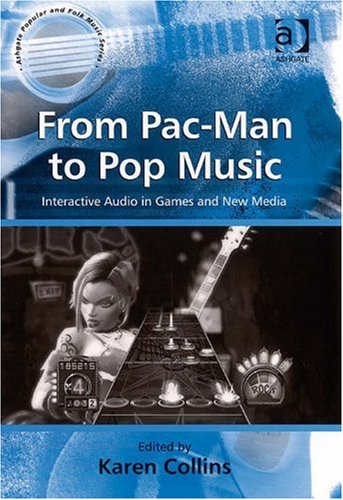
The idea of categorizing games by their status as cultural artifacts and then mixing their audio accordingly seems like a tremendously complicated subject. But I do like the idea of considering the basic nature of a video game and its intended audience before making decisions about its dynamic range. When so much discussion is going on regarding the creation of universal standards of dynamic range in the game industry, ideas like those proposed by Bridgett seem well worth discussing. The article is a fascinating read, and you’ll find it in the book, From Pac-Man to Pop Music, edited by Karen Collins.

From Pac-Man to Pop Music: Interactive Audio in Games and New Media

From Pac-Man to Pop Music: Interactive Audio in Games and New Media

Speaking Engagement: GameSoundCon 2013

I wanted to let everyone know that I’ll be speaking at GameSoundCon, which takes place in Los Angeles on Nov. 3-4, 2013. It’s a fantastic educational summit in which game audio professionals give lectures, provide tips, discuss techniques and share insight into the process of creating great game music and sound. Held every year since 2009, the conference is run by Brian Schmidt. He’s a winner of the Game Audio Network Guild’s Lifetime Achievement Award, he’s an inventor for about 20 patents in audio and game technology, and he’s in the faculty of the DigiPen Institute of Technology.

I’m honored to be chosen to speak at this conference. I’ll be giving a talk in the GameAudioPro Track, which is designed to offer content for more advanced game audio professionals.  The conference takes place this year at the Los Angeles Convention Center. It’s the first time that GameSoundCon has been held there.

LACC

The conference will immediately precede GDCNext, which is taking place in the same venue. Since GDCNext doesn’t have an audio track, the synergy between the two events should be very complimentary!

Here’s one of the GameSoundCon lectures that Brian Schmidt gave at the 2010 GameSoundCon:

Also, you can read more about GameSoundCon at the GameDev.net site.

Finally, here is a review of last year’s GameSoundCon written by sound designer Uriel Salazar.


Rest in Peace, Game Developer Magazine

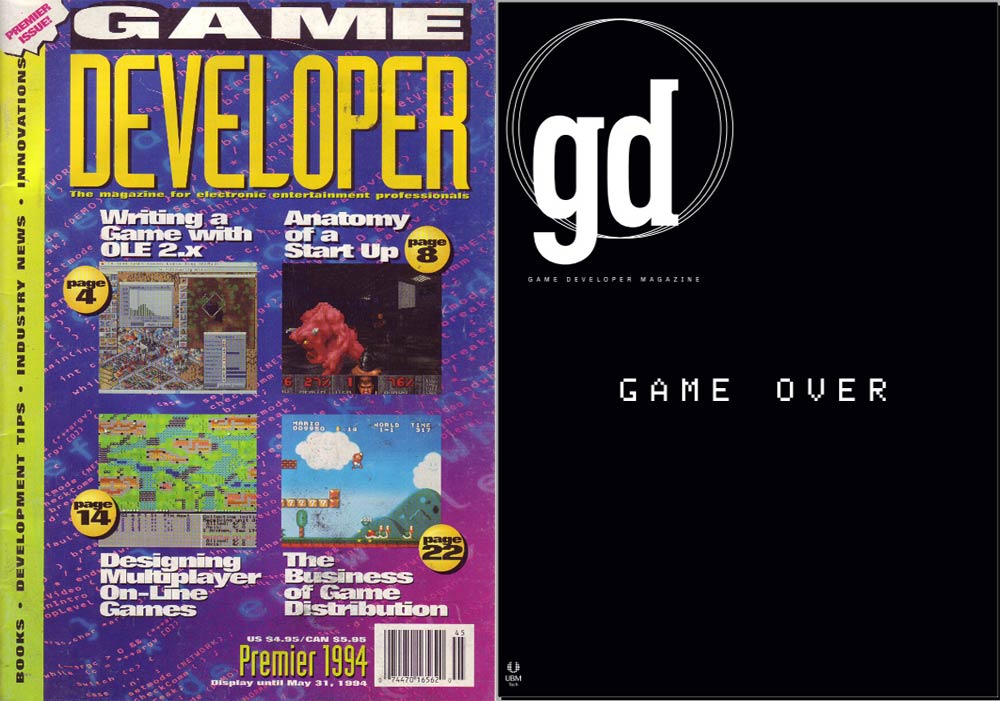
GDPremier&Final

I was incredibly saddened to hear that Game Developer Magazine was to cease publication. I’m looking at the magazine as I write this. It has a bleak jet-black cover with the words GAME OVER, dead center in plain white lettering. Those two words bring a pang to my heart.

When I attended my first Game Developers Conference, I was offered a free subscription to the magazine as part of my registration process. I signed up for the subscription right away – it was a bit of a thrill for me. For someone so new to game development, being offered that free subscription felt a little like a secret initiation – as though I had been found worthy of joining the community and would now receive the benefit of knowledge that only the insiders knew. Of course, I was well aware that this was a tremendous exaggeration, but a part of me clung to the conceit that the magazine subscription was a little rite of passage.

I rarely read the magazine in any organized, consecutive manner. Mostly, I enjoyed opening to random pages and reading whatever article I saw there. The Design of the Times articles were eye opening for me, providing tremendous insight into the struggles of designers. I had no idea that the pursuit of the fun factor would be so remarkably complex, requiring such a deep knowledge of psychology, economics, and the long and rich history of game systems from both the ancient past and the present day. With every issue, my appreciation for the struggles of game designers grew.

Articles about programming languages, artificial intelligence and physics were written in an arcane lingo that skimmed my consciousness in the same way that liturgical Latin might have done. This was the language of the ancient society of technicians, engineers and coders – it wasn’t meant for me. Nonetheless, I did read a lot of these articles, because now and then there would be a moment of humor, a glimpse of pathos and exhausted camaraderie, or a spark of enthusiasm and inspiration that would reach out of the labyrinthine text and capture my imagination. If I had overheard such a conversation at the watercooler, and one of the engineers noticed me listening and gave me a shrug and a smile… that feeling is close to how I sometimes felt, reading those articles.

The interviews were always surprising and interesting. It seemed to me that there must have been something about the journalists of Game Developer Magazine that inspired people to speak with startling frankness and gritty honesty. I read blunt observations about the video game marketplace. Successes and failures of games were discussed in the context of economic realities and the changing expectations of gamers. Prominent developers openly grappled with the problem of fitting their creative aspirations into a business model that sometimes couldn’t accommodate them. Triumphant developers crowed about their bestselling games, and hardened veterans shared war stories about the big hits that almost were.

Of course, I eagerly pored over the Aural Fixation column, since it focused on the audio side of game development. The technical articles were always fascinating, and this extended into the audio product reviews. Several products that I first learned about in Game Developer Magazine are now a part of my working life.

I loved the Arrested Development column at the back of the magazine, where the keenest observations about game development would come leaping out of the magazine, dressed in the disguise of sharp and irreverent humor. This sweetly acidic dessert at the end of the meal was always the perfect finish… but I’ll admit that I often ate dessert first.

As a magazine that depended on advertising revenue to stay afloat, Game Developer Magazine was wounded deeply when many of the companies making software development tools consolidated. Where before, there were many software companies buying ad space in the magazine, now there were only a few. For the magazine’s parent company, the meager profits simply couldn’t justify the continuation of Game Developer Magazine. The decision was made, and that final issue with the stark black cover was shipped out. GAME OVER.

Nothing I can write here could adequately pay tribute to Game Developer Magazine.  It provided me with a connection to an industry I loved. Every month, the magazine helped me to cultivate a deeper understanding of the struggles and successes of my fellow developers, and for that I am grateful. My heartfelt thanks go out to the writers and editors of Game Developer Magazine, for their creativity and their passion.  I’m sure that they will all find great opportunities awaiting them in the field of digital games journalism, and I am looking forward to reading their contributions… but I will miss the unique combination of talents and personalities that made up this dynamic team of writers.  Thanks to one and all for the many years of insight, instruction, and community spirit that you shared with me.  I’ll never forget it.

You can read the entire final issue of Game Developer Magazine in a free PDF that they’ve made available at this link. Below you’ll find a list of the former editors-in-chief of Game Developer Magazine, along with either their Twitter pages (if applicable) or their LinkedIn profiles.

Patrick Miller @pattheflip

Brandon Sheffield @necrosofty

Alex Handy

Jamil Moledina @jmoledina

Simon Carless @simoncarless

Jennifer Yeamans (Olsen)

Alex Dunne @adunne

Mark DeLoura @markdeloura

Larry O’Brien @lobrien